
Bench Warrants in Carver County
A bench warrant in Carver County is the court's answer to a no-show. Skip a hearing date, or ignore a court order, and the judge on the case signs a warrant for your arrest. The Sheriff's Office defines it that way, and the definition matters. This is not a warrant accusing you of a new crime. It enforces a case that is already open. Carver County files bench warrants beside complaint warrants, probation-violation warrants, and release-condition warrants, so the label on a record tells you which obligation produced it and which office can clear it.
What Triggers a Bench Warrant in Carver County
Four situations account for most Carver County bench warrants. Each one moves through a different part of the system, so read the four below with that in mind.
| Trigger | What It Means | Who Acts |
|---|---|---|
| Missed court date | A failure to appear on a scheduled matter | The judge on the case |
| Unpaid fine | An ordinance or traffic fine left unpaid in a violations-bureau matter | The court, under Rule 23 |
| Missed condition | A court-ordered step, treatment, or payment plan not completed | The judge on the case |
| Contempt or support | A civil, family, or probate obligation left unmet | The judge in that division |
How a Carver County Bench Warrant Is Issued
A Carver County judge issues a bench warrant from a case already open. Most carry no new charge behind them. The order simply lets law enforcement take the person into custody and bring them before the court on the existing matter. Once signed, the warrant enters the court record and the Sheriff's operational data, and it stays there. What closes it is one of three things: the person appears, the court recalls it, or the case resolves another way. A recall is a court action alone. The Sheriff cannot produce one on request, no matter how politely you ask.
Missing Court in Carver County: The Bench Warrant Risk
Missing court in Carver County does not always mean a warrant the same day, but it does start a process. The judge may reschedule, issue an order to show cause, or issue a bench warrant, depending on the case and the history. Call Court Administration at 952-361-1420 as soon as you know a date was missed, and ask what the judge has ordered. Then check with the Warrants Division at 952-361-1281 on whether a warrant exists. Acting early keeps the options wider.
Bench Warrant vs Arrest Warrant
On a list row in Carver County, a bench warrant and an arrest warrant look the same. In practice they behave differently. A bench warrant enforces a case that already exists. An arrest warrant starts one.
| Feature | Bench Warrant | Arrest Warrant |
|---|---|---|
| Trigger | A missed court date or unmet obligation | Probable cause of an offense |
| Basis | An open case the person did not appear on | A new charge under review by a judge |
| Underlying case | Already filed and scheduled | Opened by the complaint |
| How it clears | Appearance, recall, or quash | Surrender, bond, or a court appearance |
The arrest warrants page covers how a Carver County probable-cause warrant is obtained and served.
Sign and Release Warrants in Carver County
Minnesota built a narrower path for one common situation. Under Minn. Stat. § 629.415, effective January 1, 2024, a qualifying misdemeanor or gross misdemeanor failure-to-appear warrant can be handled through sign and release rather than an arrest. The conditions matter, and the statute spells them out. The summons had to be mailed and returned undeliverable. The person had to fail to appear. There can be no previous failure to appear, and the statutory exclusions must not apply. When everything fits, an officer provides a new written court date, records updated address and signature information, files the required form, and clears the warrant. Note that the process does not authorize an arrest, and it does not close the case.
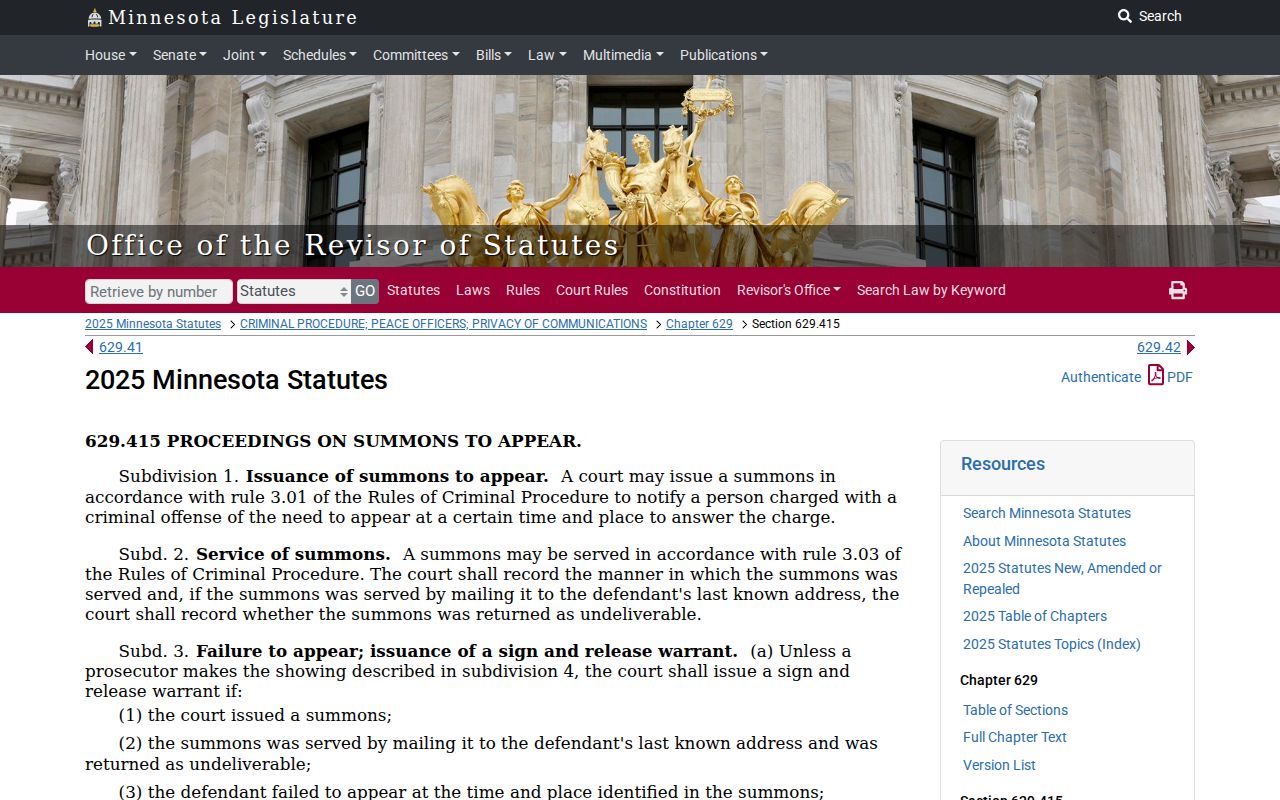
Sign and release is not self-service in Carver County. The officer or the court decides eligibility, not the person named in the warrant.
How to Resolve a Carver County Bench Warrant
Work each step in order, and remember that the Carver County bench warrant and the case beneath it travel on separate tracks.
- Confirm the warrant and the court file number with the Warrants Division.
- Ask Court Administration which judge and which case hold the warrant.
- Talk to an attorney about a motion to recall or quash and about the underlying obligation.
- Resolve the obligation: pay the fine, restart the plan, or set the missed matter back on the calendar.
- Confirm the status after the action, then recheck the county list at its next refresh.
Caution: Do not ignore a bench warrant. It does not expire on its own, and it can surface at a traffic stop or in any contact with law enforcement.
Civil and Family Bench Warrants in Carver County
A bench warrant is not always criminal. In Carver County, the Sheriff's Office lists contempt, child support, conservatorship, guardianship, and debt collection among the civil, family, and probate matters that can spawn one. Access works differently for those files. Some family and probate cases are restricted. A public search may return nothing at all, so Court Administration is the right first call. The division holding the case decides what it can release.
Which Carver County Court Issued the Bench Warrant
Carver County funnels nearly everything through one court. The District Court there handles criminal, traffic, ordinance, family, probate, and juvenile matters. One assigned judge stays on the case. That judge also controls any recall of the bench warrant. So the Sheriff cannot touch the legal side; ask Court Administration to identify the file and division, then send the motion there.
Rule 23 and Carver County Ordinance Warrants
Minnesota Rule of Criminal Procedure 23 sets up a violations-bureau path for payable ordinance and traffic matters in district court. Paying the fine can replace an appearance. Skip both, though, and the rule lets the court issue a bench warrant. Bail gets set at the fine amount. That is how an unpaid Carver County ordinance ticket becomes a warrant, with no new criminal charge attached.